
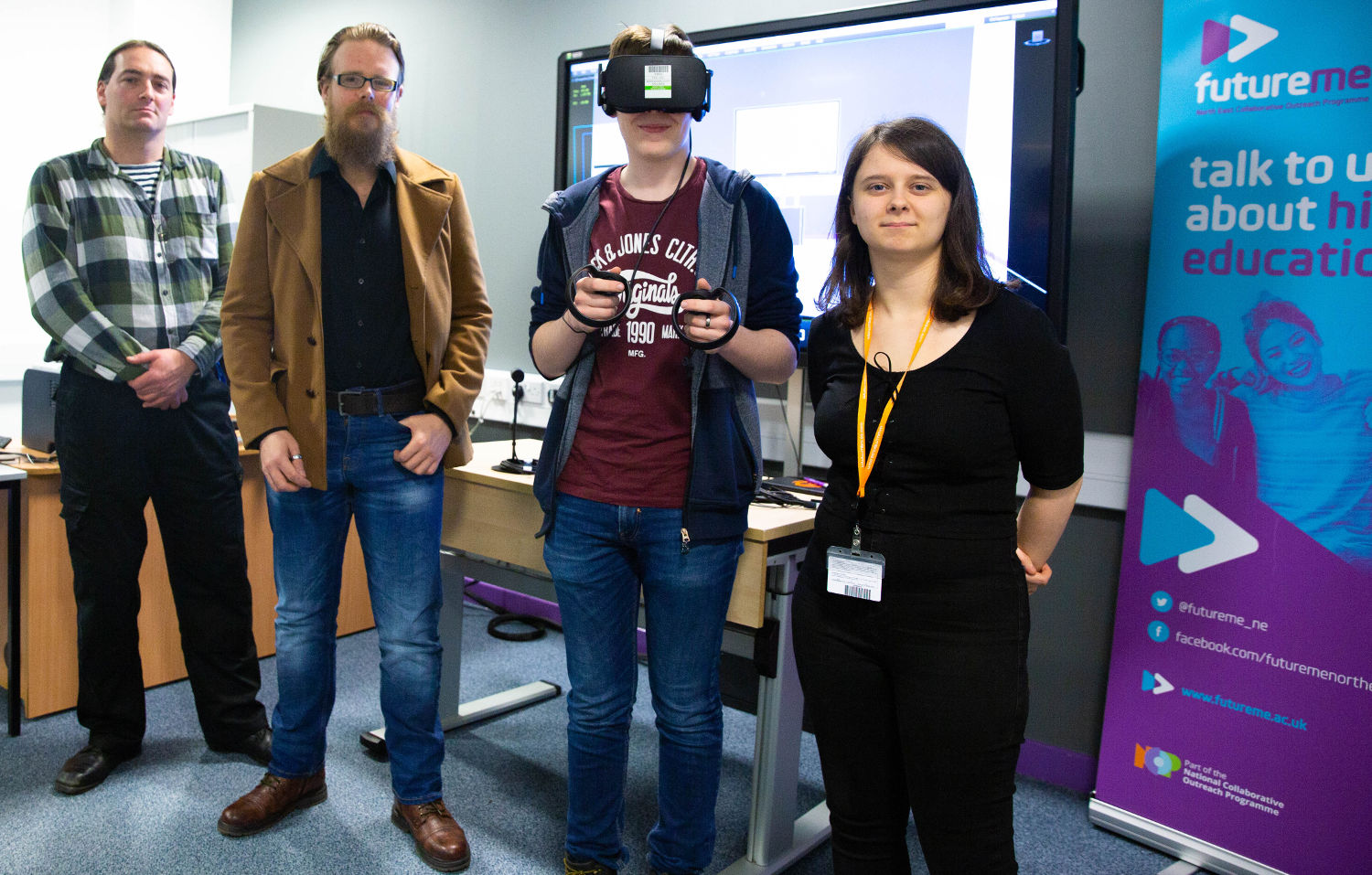
Budding games designers entered a virtual reality thanks to an industry expert’s visit to Middlesbrough College.
Students at Middlesbrough College created a 3D model of their design studio – and got the chance to see how their model could be evolved, thanks to an inspirational meeting with a local company.
The project formed part of FutureMe, a programme of activity designed to help students understand the educational pathways available to them.
Delivered by the North East Collaborative Outreach Programme (NECOP), students take part in a range of activities that give them a taste of what higher education could be like.
It’s hoped the students’ model will be used to train other learners at the College, including trainee electricians who can use it as a learning tool.
Dan Riley, managing director at Teesside-based Spearhead Interactive visited the students with senior 3D artist, Ken Turner, to take a look at the project and offer advice on how it could be turned into a virtual reality (VR) experience.
Dan said: “We have been thrilled to support the passionate students at Middlesbrough College and have enjoyed providing feedback on their model, demonstrating new modelling techniques and offering insight into the applications of 3D visualisation across a number of industries outside of gaming.
“Immersive and interactive technologies are having a significant impact on a wide array of sectors and industries around the world.
“We expect commercial demand for skilled 3D artists to increase greatly as the technology matures – and these students are well placed to take advantage of this.”
Mark Lord, programme leader for HE Games Design at Middlesbrough College, added: “This project has been a fantastic opportunity for our students to understand some of the careers available to them working with new and emerging technologies such as VR.”
Middlesbrough College offers a range of games design courses aimed at students at all levels – from entry level to Access to Higher Education (HE) options.
New funding support to help the region’s employers create more apprenticeships has been launched by the Tees Valley Mayor and Combined Authority.
The Combined Authority has provided more than £2.3million in grants to local businesses, supporting the creation of more than 1,100 apprenticeships.
New changes to widen the scope of the Apprenticeship Support for Employers scheme, which take advantage of more fast-growing sectors, have been unveiled at an event at Hartlepool College of Further Education
The new offer for employers looking to take on apprentices includes a sliding scale of support related to the level of the apprenticeship created and priority sectors expanded to include construction and care for the elderly.
Tees Valley Mayor Ben Houchen said: “University isn’t the only way to open doors to high-quality, rewarding careers – apprenticeships let our employers benefit from dedicated staff who get the experience they need to get on, and the skills businesses need to thrive.
“Widening the scope of our apprenticeship support will help drive forward even more growth in our key areas. For example, with an ageing population, the need for elderly care is increasing. Construction roles will continue to grow even faster with our aspirations to invest in and develop the regional economy, including through the South Tees Development Corporation, the biggest development opportunity in the UK today.”
Cllr Christopher Akers-Belcher, Combined Authority Cabinet Lead for Education, Employment and Skills, said: “Apprenticeships are a fantastic way for people to earn while they learn and they make a real contribution to the lives of Tees Valley’s residents and our economy.
“We have done a lot to help encourage take-up and by altering our offer, we can take advantage of the emerging opportunities for our local people, helping them to succeed in an even wider range of careers.”
Grant A is offered on a sliding scale and is related to the level of the apprenticeship:
Levels 2 & 3 – £2,000
Levels 4 & 5 – £3,000
Levels 6 & 7 – £4,000
An additional grant of £2,000 would be offered for each progression should an apprentice move between levels three to seven This grant is available for small to medium businesses (249 or fewer employees) from Tees Valley Combined Authority’s identified priority sectors who employ an apprentice aged 19+, working towards a recognised Apprenticeship Standards or Frameworks (up to a maximum of three apprentices per year).
Grant B would be available for employers from any sector and would offer a sliding scale relating to the apprenticeship level, with Levels 2 & 3 awarded £500 and Levels 4 to 7 granted £1,000. If the apprentice is progressing between levels 3 to 7 an additional grant of £1,000 would be offered for each progression. This grant is available for small businesses (49 or fewer employees) who employ an apprentice aged 19+, (up to a maximum of three apprentices per year).
To find out more and to apply, businesses are urged to visit www.teesvalley-ca.gov.uk/apprenticeship-support
Teesside University’s innovation in the construction sector has been recognised as one of the UK’s 100 best breakthroughs for its significant impact on people’s everyday lives.
Professor Nashwan Dawood, Associate Dean (Research and Innovation) in the School of Science, Engineering & Design, led pioneering research into the development of integrated 5D modelling – 3D modelling that includes time efficiency and cost management dimensions.
The work, which continues with the Smart Energy Systems and Energy Informatics research group at Teesside University, involves the development of innovative digital technologies for building and energy information modelling processes.
The impact of the research has been far-reaching, with 5D principals being used across the UK, South Korea and Malaysia. It has also been employed in the ground breaking ‘Virtual Construction Site’ development, which enabled project managers to visualise detailed information prior to commencing construction.
The list of breakthroughs, compiled by Universities UK, demonstrates how UK universities are at the forefront of some of the world’s most important discoveries, innovations and social initiatives and also highlights the less celebrated, but vital breakthroughs, that transform lives.
The UK’s 100 Best Breakthroughs is part of University UK’s MadeAtUni campaign which is shining a spotlight on universities and the difference they make to people, lives and communities.
Professor Simon Hodgson, Pro Vice-Chancellor (Research and Innovation) at Teesside University, said: “It is a fantastic achievement for the University to be featured in the UK’s Best Breakthrough list. We are extremely proud of the work of our academics and the difference they are making to people, lives and communities.
“The MadeAtUni campaign is an important national intake which aims to demonstrate the enormous impact that the research carried out in the University sector by Teesside University and others has on the lives of individuals, and the success of business.”
Professor Dame Janet Beer, President of Universities UK, said: “Universities really do transform lives. The technology we use every day, the medicines that save lives, the teachers who inspire – all come from UK universities and the important work being done by academics.
“The UK’s Best Breakthroughs list is a testament to the difference that universities make to people’s lives and we want everyone to join us in celebrating the work they do.”
The UK’s Best Breakthroughs list: 100+ Ways Universities Have Improved Everyday Life was put together in partnership with universities across the UK. The entries cover health, technology, environment, family, community and culture and sport.
An engineering company is putting ambitious expansion plans into action, thanks to support from Innovate Tees Valley and Teesside University.
Industrial and Marine Hydraulics (IMH), a Middlesbrough-based hydraulic engineering company is about to embark on a major overhaul of its systems and processes in preparation for a period of sustained growth.
Over the next three years, the company is planning to double its turnover and take on an extra 10 staff, alongside a major investment in machinery and facilities.
Founded by hydraulics engineer Paul Griffiths, IMH has grown from a home-based business in 1983 to a leading global player in hydraulic engineering, with experience of working across more than 50 countries.
IMH delivers major hydraulic engineering projects and its capabilities include design and build, manufacturing, installation, commissioning, servicing, maintenance and repairs, as well as component supplies and training.
The company has extensive experience of providing hydraulic engineering expertise and solutions to sectors including oil and gas, marine, subsea, energy (including renewables), nuclear, infrastructure, manufacturing and automotive.
Dr Osama Alaskari, a former Teesside University PhD student, has been working at the company as a Systems Analyst on an 11 month project to review all of its systems, processes and procedures to ensure that they can accommodate this growth.
He has been assisted by Dr Ruben Pinedo-Cuenca, business innovation manager in the School of Science, Engineering and Design who specialises in Enterprise Resource Planning (ERP).
Innovate Tees Valley, funded by the European Regional Development Fund and led by Teesside University, helps small businesses to try new things and improve or develop products, services and processes.
Innovate Tees Valley’s Knowledge Exchange Internship (KEI) programme has been able to part-fund Osama’s salary and Dr Pinedo-Cuenca’s consultancy.
IMH, Commercial Director, James Griffiths said: “This is the most transformational project this company has undertaken in its 35 year history.
“It’s unbelievably exciting, but it’s really important that we get it right.”
General Manager at IMH, Ian Duffew added: “As we move into Industry 4.0, the businesses that thrive will be ones that have incorporated technology to its fullest.
“We see a massive opportunity to improve what we have and want to automate as many of our processes as possible throughout the business.
“However, that’s not without its challenges and we realised that we didn’t have all the answers, so it was great to be able to utilise the University to bring in new skills.
“As an SME, the fact that Osama has been able to come in and dedicate himself to this project has been fantastic.
“We would still be talking about doing this project if it wasn’t for the work that he has done.”
Dr Pinedo-Cuenca said: “We are delighted to have been able to help Industrial and Marine Hydraulics. It’s fantastic to be able to work on a live project like this.
“Osama has also been teaching at the University and the experience and information he is passing on to the students will be invaluable in supporting the academic activities of the University.”
Both the University and IMH hope that projects like this will have a positive impact on how industry and academics work together to achieve long-term sustainability and business success.
For more information on Innovate Tees Valley visit www.innovateteesvalley.co.uk
A business founded by two Teesside University aerospace engineering students which plans to launch the first civilian space mission in the UK has won a major start-up competition.
StratoBooster was named as having the ‘Highest Growth Potential’ as well as being named as ‘Ones to Watch’ in the 2018 If We Can You Can (IWCYC) challenge.
The business has been founded by Andrew Dunn and Ben Massey, who are both in their final year of a BEng(Hons) Aerospace Engineering, and is based at Teesside University’s start-up incubator Launchpad.
StratoBooster was originally spun out of a student-led space exploration project, TU2Space, and is working on researching, designing and constructing a small satellite launch platform.
The StratoBooster rocket will ascend to 30km via a meteorological balloon before detaching and using a rocket booster to fire its payload into orbit.
The rocket will launch small payloads including tiny satellites, known as femtosatellites, which can be used by researchers in businesses, schools and universities.
The small-scale nature of the rocket means that payloads can be delivered to space at a fraction of the cost of other commercial alternatives.
The business has already won support from the University Alliance which awarded Stratobooster £3,000 investment.
Andrew and Ben also recently completed the DigitalCity Fellowship Accelerator which works with Tees Valley entrepreneurs to offer funding, workshops and bespoke consultancy as they develop their product or idea.
Now in its 10th year, the IWCYC Challenge aims to publicise and connect start-up businesses with the wider North East business community. From Northumberland to Teesside, the challenge is open to all sectors looking for regional opportunities and to connect with existing well-established businesses.
As a result of winning the IWCYC Challenge, the pair will be given support to grow their business, including mentoring and a trip to a European conference or expo.
Andrew said: “It was fantastic to win this competition. Not only was it great to get the recognition, but it’s a real vote of confidence to know that people are interested in what you are doing.
“The trip to the expo, in particular, will be extremely beneficial as we try and tell more people about our business.
“We’re really excited about what we’re doing here and believe it has the potential to bring some quality graduate jobs to Teesside.
“We’ve had fantastic support throughout from the University, including from Launchpad and DigitalCity, and it was great to see so many from the University team there when we got the award.”
Laura Woods, Director of Academic Enterprise at Teesside University, said: “We’re delighted that StratoBooster have won this award.
“They have developed a truly innovative business idea with the potential to revolutionise the way space research is carried out.”
Teesside University and Hartlepool Sixth Form College are pooling their collective expertise to provide even more opportunities for young people to excel with specialist digital qualifications.
The two institutions have signed a formal Memorandum of Understanding which will see increased collaboration and engagement for the benefit of students on a broad range of courses.
Hartlepool Sixth Form College and Sunderland College successfully merged last year and jointly they have invested over £400,000 in highly specialised, industry standard digital facilities.
This includes the very first Digital Academy within Hartlepool Sixth Form College with virtual reality labs, green screen facilities, motion capture equipment and Playstation 4 Development kit.
The college is also one of a small number in the country to offer NextGen qualifications and it works with some of the industry’s top employers, including Sony, Microsoft, Double Negative and Ubisoft.
The first cohort of students in the Digital Academy are studying Games Design and Animation and there are plans to launch further courses in Computer Science, Cyber Security and Coding at A-level or equivalent.
The College has signed the Memorandum of Understanding with Teesside University as a way to develop progression pathways into higher education and to provide additional opportunities for students, as well as to collaborate on research training, events and staff development.
Teesside University’s School of Computing, Media & the Arts is at the forefront of digital technology and is a centre of excellence in the creative and digital aspects of computing, games and animation, web and multimedia.
It is also home to Animex, one of the world’s largest festivals of animation and computer games which, next year, celebrates its 20th anniversary.
The School provides a world-class learning environment with cutting edge hardware and software and its graduates have gone on to work at some of the biggest studios in animation and computer games, including Disney, Pixar, Microsoft and the BBC.
Alison Brown, Associate Dean (Marketing and Recruitment) in Teesside University’s School of Computing, Media & the Arts, said: “We are delighted to sign this new Memorandum of Understanding and it demonstrates the desire of both institutions to provide the very best opportunities in digital technology. It is about continuing to put the student experience at the heart of everything we do and sharing knowledge and best practice to build on the fantastic work which is already being carried out.
“The scale and ambition of Hartlepool Sixth Form College to enhance its digital offer is second to none and its Digital Academy is a wonderful new facility which will equip students with the knowledge, skills, and experience to make a successful transition into higher education.”
Ellen Thinnesen, Principal and Chief Executive, has overall responsibility for both Hartlepool Sixth Form College and Sunderland College.
She added: “We are delighted to be working so closely with Teesside University and to sign a formal Memorandum of Understanding with an institution which has a global reputation for games, animation and digital technology.
“We are at the start of an exciting journey at Hartlepool Sixth Form College and by working collaboratively with staff and students at Teesside University, I am confident that we can achieve great things together.”
Mark Hughes, Head of Hartlepool Sixth Form College, said: “We are extremely passionate about our Digital Academy and believe we have a first-class facility which is vitally important to young people in this area.
“It is a huge step change for the college and, by strengthening our partnership with Teesside University, we will be able to provide even more opportunities in what is a rapidly developing sector.”
Teesside independent commercial property consultancy Dodds Brown hosted more than 40 London-based urban planning students on a tour of Middlesbrough’s key commercial property sites.
The final year students from University College London’s (UCL) Bartlett School of Planning learned more about the regeneration of Middlesbrough from Dodds Brown Senior Partner Stephen Brown and Senior Associate Partner Richard Wilson in a lecture and walking tour of Middlesbrough town centre which took in the new Centre Square office development.
The talk and tour was part of a two-day trip to Teesside for the urban planning students to find out more about the regeneration of the region.
Mr Brown says: “It was a good opportunity to ensure that students from one of our most prestigious schools of planning could see for themselves what is happening in a region that is often overlooked by London. They can learn a lot from the plans for Teesside’s and Middlesbrough’s regeneration.
“In fact, in the future some of them might find themselves working in planning in our region, as there is so much exciting development underway.”
Dodds Brown is working with the UCL students because of its very active role in the regeneration and development of commercial property across Middlesbrough and Teesside.
It is presently advising on the new restaurant and leisure destination on Albert Road, on the new grade A offices in Centre Square, on the Snow Centre and office developments at Middlehaven, on Dundas Shopping Centre, on Tees Advanced Manufacturing Park, on the new North Yorkshire Moors’ potash mine, on offices and laboratory space at Wilton Centre and on office space at Wynyard Business Park.
Teesside University has received a prestigious award as part of its commitment to gender equality across the institution.
The University has been conferred an Athena SWAN Bronze award, which it will hold for the next four years.
Established in 2005, the Athena SWAN Charter is designed to recognise and encourage a commitment to advancing the careers of women in science, technology, engineering, maths and medicine (STEMM) throughout higher education and research.
The Bronze award for Teesside highlights the University’s work in gender equality and in developing an inclusive culture that values all staff.
Teesside University became a member of Athena SWAN in 2014 and has worked to embed the Athena SWAN principles across all of its activity, striving to set the highest possible standards for equality and diversity.
The University has appointed Athena SWAN Champions to steer the strategy at both School and Departmental level and has also implemented a communications group to raise awareness of the commitment to Athena SWAN and the opportunities which it creates.
Professor Jane Turner OBE DL, Pro Vice-Chancellor (Enterprise & Business Engagement) and the University’s executive champion for gender, led the Athena SWAN submission.
She said: “I am absolutely delighted that Teesside University has been conferred an Athena SWAN Bronze award until 2022.
“We have a long standing commitment to equality and diversity and have embedded this within our corporate strategy, Teesside 2020, which includes empowering individuals, embracing diversity and actively opposing prejudice, as underpinning values.
“I would like to thank everyone involved across the University for supporting and embedding the Athena SWAN principles into their work.
“The Bronze award is a fantastic achievement, but it is not the end of this journey. We will continue to drive this agenda and set the highest possible standards for equality and diversity.”
The Athena SWAN Bronze award is further recognition for Teesside University as an employer which values high performance and realises the potential of its people.
Earlier this year, Teesside University was awarded Gold accreditation against the Investors in People (IiP) Standard for the third year in a row, putting Teesside alongside the top performers within the IiP community. It was also named in Stonewall’s annual list of the top 100 employers.
Middlesbrough College has achieved a ‘good’ Ofsted rating following a “huge” investment plan.
Inspectors praised the college for a positive culture, high grades, employment outcomes and strong curriculum that meets the needs of Teesside.
They also highlighted well-qualified staff with industrial experience who deliver courses in well-equipped learning environments.
It comes as the latest Department for Education statistics have shown Middlesbrough College was the highest performing Tees Valley college, with 97% of its students securing employment, an apprenticeship or moving on to university.
Principal and chief executive Zoe Lewis said: “There has been a huge investment plan, focusing not just on buildings and equipment but a lot of new staff.
“We brought in 100 people from apprentices to teachers and support people in areas of high skills shortages.
“We were really pleased that Ofsted picked up our culture, they used phrases I’ve never seen in a report before such as ‘welcoming and harmonious environment’, ‘good behaviour’, ‘positive attitude’ – that’s what we see every day.”
Ofsted said students are “highly motivated” and enthusiastic with positive attitudes.
The report also emphasises Middlesbrough College’s culture and environment, describing it as caring and supportive with an ethos of raising aspirations.
Inspectors observed students were “eager to learn” and felt safe in college, valuing the support they received.
Students also benefit from a wide range of enrichment activities and compete successfully in regional and national skills competitions.
But they also said the College’s apprenticeship provision requires improvement.
Ms Lewis responded with: “Middlesbrough College is in the top 30% of apprenticeship providers across the country and Ofsted has acknowledged the experienced and knowledgeable tutors we have.
“It points to the success of our apprentices in developing the skills, knowledge and behaviours that meet the needs of their employers and most importantly, the fact that almost all apprentices remain in employment following their apprenticeship.
“However, we agree with Ofsted that nationally too few apprenticeships complete their programme due, often, to reasons associated with their employment.
“We are therefore committed to working with our employers to ensure our apprentices have the best possible chance of success of completing their programme in a timely manner and are committed to continually improving all of our provision including our apprenticeship provision.”
Students and graduates seeking advice on job opportunities are invited to a careers fair at Teesside University.
The event will take place from 10.00am to 2.30pm on Friday 2 November 2018 in the University’s Olympia building.
Visitors will have the opportunity to speak to a host of potential employers and find out what careers, jobs, placement and study opportunities are on offer.
Organisations from a wide range of companies and industries will be in attendance, including GlaxoSmithKline, NHS Professionals, North Yorkshire Police, the Royal Air Force and Thirteen Group among many others.
All current higher education students and graduates of all universities are welcome to attend. Entry is free and there is no need to book.
The careers service at Teesside University offers an impartial service to help students choose their future career and gives advice on applications and interviews. Graduates are welcome to use the careers service for up to two years after they graduate.
For more information visit tees.ac.uk/careers.
