
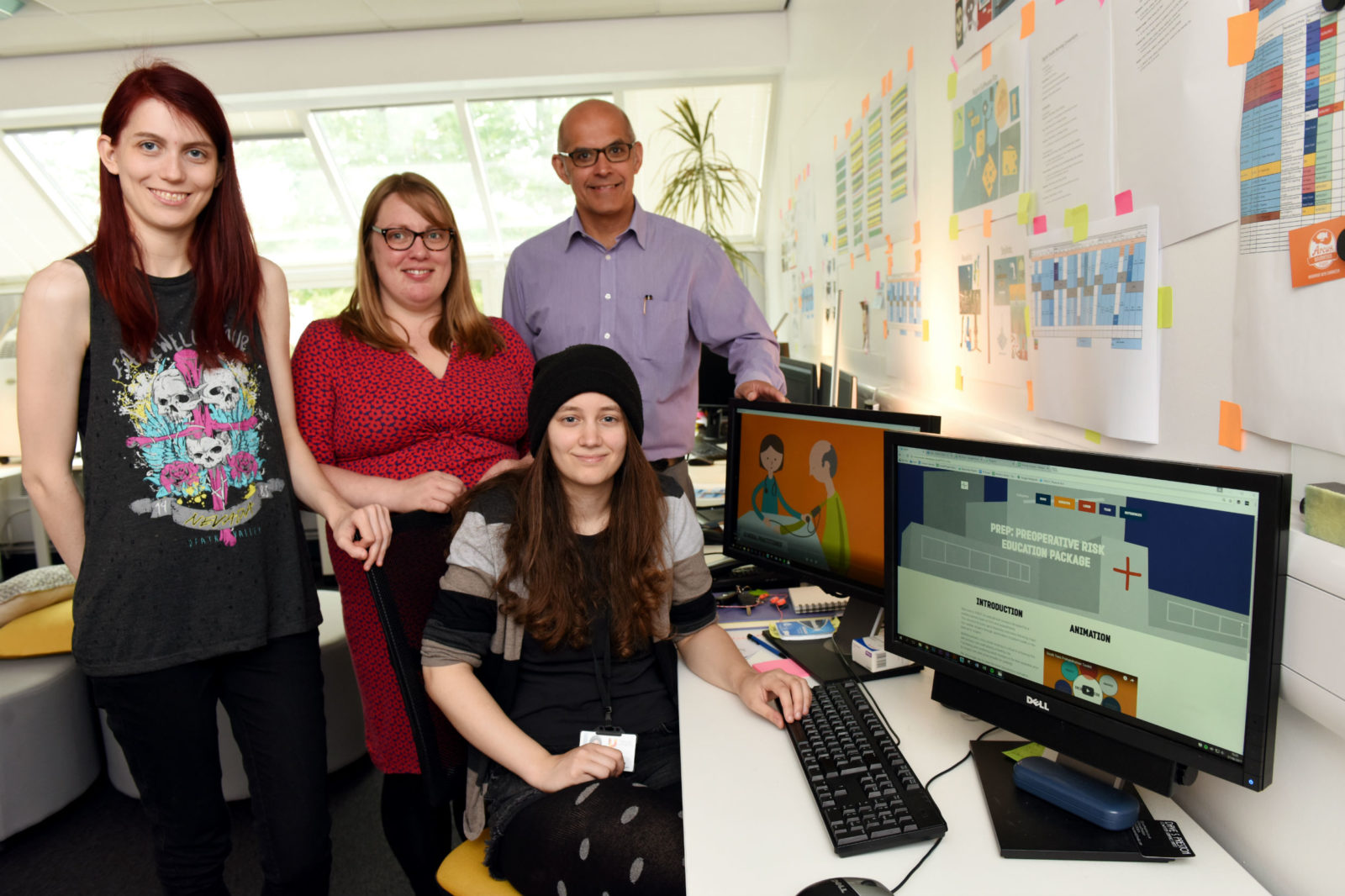
Computing graduates at Teesside University have been using their digital skills to develop innovative ways to help health organisations keep staff and the public better informed about new initiatives.
The Digital Studio in Teesside University’s School of Computing has been working with Public Health England and the South Tees Hospitals NHS Trust to provide accessible learning tools for health professionals and the general public.
Public Health England commissioned the University to design a digital toolkit to help people learn about the support for tackling obesity. As well as developing content for gov.uk and accompanying PDF factsheets, the Studio also produced a two minute animation for the website.
The team at the Studio has also produced an educational toolkit (supported by an innovative animation) in collaboration with doctors from South Tees NHS Foundation Trust and South Tees CCG.
The project, which is being led by Gerard Danjoux (Honorary Professor at Teesside University and Consultant in Anaesthesia), is aimed at educating primary care clinicians with respect to improving patient health and fitness prior to major surgery.
The toolkit is the first of its kind internationally and recently won first prize free paper at an international conference in Edinburgh. Leading on from the success of this project the animation is presently being adapted for the patient audience.
The team are working together with the Royal College of Anaesthetists to secure high-level national healthcare endorsement and adoption of the toolkit.
The Studio has been developed as part of Teesside University’s employability agenda and consists of 10 graduate interns from the School of Computing who have been working on a series of internal and external digital projects.
Kayleigh Stevens, a BA (Hons) Computer Games Animation graduate, said: “It’s been a fantastic experience working on these projects.
“It was quite nerve-wracking at first as I was involved quite heavily in dealing directly with the clients, so it was a massive learning curve.
“However, the University has been really supportive and given me all the help and encouragement I needed.”
Siobhan Fenton, Associate Dean (Enterprise & Business Engagement) in Teesside University’s School of Computing, said: “Working on live projects like these has fantastic benefits for everybody concerned.
“The animations are the result of some excellent multi-disciplinary working. As well as our computing graduates, we’ve worked alongside graphic designers and colleagues from the School of Health & Social Care.
“Liaising and working alongside clients gives graduates a stepping stone into employment and helps make them work ready, or maybe consider starting up their own companies.
“It’s also of enormous benefit to our staff as they are able to ascertain what employers are wanting from students and this helps inform their teaching.”
For more information on courses in the School of Computing visit www.tees.ac.uk/computing
A unique health and wellbeing centre – believed to be the first of its kind – has officially opened in Middlesbrough.
The Live Well Centre is based across five floors of Dundas House and is a one-stop shop to support people in changing their lives for the better across a full spectrum of life issues.
The Live Well Centre has been made possible by an £800,000 refit of the previously disused space further helping the town’s ongoing regeneration.
Middlesbrough Mayor Dave Budd said: “It is designed to help people help themselves, a one-stop shop if you like, for different services.
“We have really difficult health problems in the town and have had for a long time. We have very great health inequalities and this is part of a programme to address that as well as the obvious things like education and tackling poverty and jobs and better housing.
“It is unique and we are very proud that this centre is the first of its kind in the country. I think as people walk around and see the breadth of what is available here they will be really blown away by the possibilities.”
Recovering alcoholic Jill Fidan, 54, from Middlesbrough, has been sober for 12 years and now works within The Live Well Centre’s needle exchange.
She said: “I lost everything to alcohol. From personal experience I am 12 years sober and it has been the best 12 years I have had. The Live Well Centre is here for people to come down with anonymity, it’s not stigmatised, you just come along and all the services are here under one roof to give you the help that you need.”
Edward Kunonga, Middlesbrough’s Director of Public Health, said: “Very often people don’t have one single issue and bringing services together helps to address that but also we know it helps to take away the stigma.
“If you walk into this building who knows what you are coming in for, it could be cooking on a budget, you could be coming to a mental health session, you could be coming for employment advice, you could be coming to the drug and alcohol service. We feel that takes away one of the barriers.”
The development is being assisted through grant funding from Public Health England and Big Lottery Fund.
Access to The Live Well Centre will be via a reception area in the middle of the Dundas Arcade.
The refurbishment will create a wide range of mixed-use space, including community gym and fitness studio; training kitchen; eight full-spec clinics; 10 private consultation rooms; an open IT facility; café area; group, craft, training and event rooms and hireable office space.
The centre will also house a self-contained family unit, enabling families to access services together, rather than navigate separate adult, children, and young people’s services for a multitude of support services.
The Live Well Centre also has a regenerative part to play in Middlesbrough Council’s investment plans.
Over the next four years the Council is committed to an injection of £74 million into a series of developments as part of the town’s far-reaching Investment Prospectus.
The aim is that this confidence in Middlesbrough’s growing stature as the city heart of the Tees Valley will act as a catalyst for the creation of 5,000 new jobs in the town, in tandem with more than £600 million of inward investment from the private sector and other parts of the public sector.
Two young women who studied at Middlesbrough College are set to transform people’s lives with their specialist healthcare skills.
Sydney Bradley and Olivia Hodgson have ambitions to forge careers in different areas of healthcare.
Thanks to hard work and the support of Middlesbrough College the duo has pipped other young hopefuls to top university places, starting in September.
Sydney Bradley has secured a conditional offer from Teesside University to study Paramedical Sciences – an exciting degree that prepares people for the demanding and vital role of pre-hospital care.
The 17-year-old, one of just 40 from 2,000 applicants to secure offers for the course, has ambitions to become a paramedic specialising in stroke and heart attack treatment.
She was inspired to follow this route having lost a number of family members to such conditions.
Sydney said: “This type of work is physically and mentally demanding. The training teaches you to deal with fast-moving, traumatic situations.
“It’s a really difficult job to do, but because I’ve lost people in my family, I’m determined to make a difference.
“I’ve been working for Medics UK – a private ambulance firm – covering marathons and similar events. It’s given me great experience, but the support of Clive at Middlesbrough College has really helped me get to get where I am now.”
Olivia Hodgson, from Berwick Hills, Middlesbrough, is set to study Mental Health Nursing at the University of York in September.
The 17-year-old is poised to complete a BTEC in Health and Social Care at Middlesbrough College, and now has an offer to study on the four-year course, including Master’s qualification.
Having completed 100 hours of work experience at specialist dementia care home Evergreen Court, Olivia said her Middlesbrough College tutors supported her to earn the coveted offer from York.
She said: “I wouldn’t be where I am now without the help of the tutors. They helped me put together a personal statement which obviously impressed the University admissions team.”
Olivia has long-term ambitions to work in mental health care in prisons or secure institutions, having originally been inspired by a TV documentary.
She added: “I was also inspired because I knew someone who had mental health problems and I developed empathy for people like that, it pushed me to support people who feel down.”
Experts at Teesside University are part of a ground-breaking healthcare project designed to help people with back pain manage their own condition.
The North of England Regional Back Pain Programme is a collaborative initiative which could have a major positive impact – both in terms of health treatment and finances and resources.
Most people suffer from back pain at some stage of their lives and the programme has drawn up seven golden rules to allow people to self-manage their condition, rather than seeing a consultant or GP. The rules include advice such as keep moving, avoid bed rest during the day, stay active and don’t be afraid to take simple painkillers.
In addition, an app has been devised, allowing participants to give regular feedback and updates about their condition.
Professor Denis Martin, from Teesside University’s School of Health & Social Care, has been involved in the evaluation of the project.
He said: “The programme is all about encouraging people to stay positive – keep moving and the back pain will subside in time. Most back pain will start to fade within two weeks and will settle in six weeks. X-rays, scans or treatment are not usually needed.
“We are working to ensure that people with back pain get to the right person, in the right place, at the right time.”
The North of England Regional Back Pain Programme is a three-year project which has received half a million pounds of funding to try and streamline care for people with back pain in the North East and North Yorkshire region. The team at Teesside are currently analysing data from over 6,000 participants from South Tees to assess the performance of the scheme with a view to rolling it out nationally.
The programme is a multi-agency initiative, involving Darlington CCG, South Tees Hospitals NHS Foundation Trust and the North East Commissioning Service, with funding from The Health Foundation, the Academic Health Sciences Network North East and North Cumbria, and the Primary Care Rheumatology Research Society.
InHealthcare, a leading provider of digital health technology, developed an app for the project to take feedback directly from patients. When patients engage with the programme, they are introduced to the app which measures their response and sends them regular questions to answer about their progress and activity.
The Teesside team is Professor Sharon Hamilton, Dr Cormac Ryan, Dr Shaun Wellburn, Professor Denis Martin, and Graduate Tutor Mary-Anne Jess, who is also working on the project as part of her PhD research.
Professor Martin added: “This is a really important programme and we are delighted to be involved.
“At the moment, when people go and visit their GP with back pain, the treatment they are recommended and the advice they receive is often quite varied.
“This programme is effectively giving people with back pain the knowledge and confidence to self-manage their condition. We believe it can have a major impact, not only on preventing unnecessary disability, but on making effective use of the health care resources which are available.”
To find out more about the North of England Regional Back Pain Programme, visit http://www.noebackpainprogramme.nhs.uk/
A young entrepreneur at Teesside University has designed an award-winning mobile app to help patients become more informed about their medication.
Health+, a business founded by Charlie Hesse, a second year BA (Hons) Graphic Design Student, is being developed and is exploring a possible partnership with South Tees Hospitals NHS Foundation Trust.
The innovative app allows patients to scan the labels on their medications and, using character recognition technology, cross-checks their prescriptions with NHS and eMC (electronic Medicines Compendium) databases.
The app informs them about what the drugs are for alongside vital information such as possible side-effects and dosage instructions. The app will also locate any potential clinical trials linked to the medication.
The aim of the app is to give patients greater detail about their medication and improve understanding.
At the inaugural University Alliance student enterprise competition, Innovating Future Business, held at Salford University recently, Charlie’s pitch to a panel of investors won him a cash prize from community workspace provider Cariocca Enterprises.
Charlie founded the business after he won the Teesside University 2016 HealthHack competition where students were given 24 hours to come up with a range of solutions to problems identified by South Tees NHS Trust.
Health+ was then given support from the Teesside Launchpad FUEL programme which offers graduate entrepreneurs up to £19,000 in support while they develop their business.
The business is based in the Teesside Launchpad incubator on the University’s Middlesbrough campus and Charlie is taking a year out from his studies in order to concentrate on launching the app.
He said: “We’re trying to get in talks with the South Tees NHS Trust about building a pilot shortly and it’s a really exciting time.
“I’ve always been interested in setting up my own business and when I heard about the HealthHack it sounded like fun.
“I didn’t expect it would lead to me setting up my own business, but I’ve had fantastic support from the University to help make the most of the opportunity.”
Laura Woods, Director of The Forge, Teesside University’s business hub, said: “It’s great to see that Health+ is proving so successful.
“Our focus at Teesside University is very much on encouraging an entrepreneurial student mindset, and it’s fantastic that a student business has grown out of one of our enterprise events. Charlie is a brilliant role model.”
South Tees Hospitals NHS Foundation Trust is looking forward to working with Teesside University on further healthcare innovations, and hopefully, future Hackathons.
Professor Andrew Owens, Director of Education, Research and Innovation at the Trust, said: “Last year’s HealthHack was a great success, generating many new and interesting ideas for improving patient care.
“I am delighted that this event has inspired a student to, not only develop a business, but more importantly, develop an application with the potential to have a positive impact on patients.
“We would like to offer our congratulations to Charlie – and look forward to speaking to him about the pilot.”
For more information about Teesside Launchpad visit www.startupteesside.co
Nine apprentices are learning how to provide a vital service to patients across the region having started careers with the North East Ambulance Service.
Carl Wilkinson, Iain Stewart, Joe Osborne, Alice Murray, Andrew Lillico, Amy Galley, Ryan Allinson, Sarah Holey and Caitlyn Skelsey have all started Patient Transport Service apprenticeships delivered through Northern Skills Group.
The cohort will all spend one year as ambulance care assistants – delivering inter-hospital transfers, hospital discharges and palliative care transport.
It’s all part of an investment in the next generation of ambulance service staff and the apprenticeships could be the beginning of great things for this group.
Andrew Lamb, education coordinator with the North East Ambulance Service, explained: “This role is seen as a great entry point for a career in the NHS, and many former ambulance care assistants have gone on to secure permanent positions as Ambulance Care Assistants, Emergency Care Assistants or train to become paramedics.
“The apprentices start with a four-week induction period, in which they learn first aid, ambulance service policy and importantly driving skills.
“Once that’s complete they’ll spend a year in the role, supported by mentors and experience Patient Transport Service staff, gaining important on-the-job experience.”
The trainees will spend the initial part of the programme at the NHS’ Lanchester Road Hospital training facility, in County Durham.
This includes tutoring which will give them a chance to earn a C1 qualification on their driving licence – allowing them to drive medium-sized vehicles.
Since 2012, the North East Ambulance Service has trained 79 apprentices – 52 of whom are still working for the trust today in a range of roles including emergency care and student paramedics.
Now as a contributor to the Apprenticeship Levy, the Ambulance Service continues to invest in future skills.
Peter Wilson, Northern Skills Group director, said: “It’s great to see another creative use of apprenticeship training in the North East as part of a carefully considered, long term workforce development strategy.
“As Apprenticeship Levy payers the North East Ambulance Service has embraced the opportunities available as a consequence of this new model apprenticeship funding and is planning its investment in skills and training accordingly.
“The Northern Skills Group team is thrilled to be supporting this cohort as they progress into jobs that are critical to the fabric of our health service.”
Teesside University student nurse Kelly Spence has received national recognition at a prestigious awards ceremony in London.
Final year BSc (Hons) Nursing: Child student Kelly won the accolade of Most Inspirational Student of the Year at the Student Nursing Times Awards 2017.
Kelly, 33, from Darlington, said: “I was overwhelmed when I found out I had been nominated and absolutely overwhelmed to have won. It was an amazing day at the awards in London and I met some inspirational people.”
Kelly added: “I am so proud to represent nursing at Teesside and want to thank my family and the University for the support they have given me.”
She chose to study at Teesside University after looking at other nursing courses. “I visited a few universities when I was thinking of doing the degree, but I was impressed most by the facilities for nursing at Teesside.
“The degree came highly recommended to me and I knew a few people who have studied here.”
Kelly added: “I have always wanted to be a nurse and had started to study at college, but I was diagnosed with epilepsy.
“I took another direction in my career, but when I turned 30 I decided to go for it and completed an access course. I also won an award from the Helena Kennedy Foundation and they helped to mentor me through my studies.
“As a mature student there was a bit of age difference among the students on the nursing degree, but we all got on so well. I’ve loved my time at Teesside and really made sure I immersed myself into student life.”
Teesside University was also shortlisted for three other awards. Sophie Proud was shortlisted as Student Nurse of the Year (Child Nursing), Catherine Thompson was nominated for BSc (Hons) Nursing Studies (Learning Disabilities) and the University was shortlisted for Nurse Education Provider of the Year (Pre-Registration).
Over £2.1 million is now available for small to medium sized enterprises (SMEs) in the Tees Valley for training. The Skills Support for the Workforce project offers fully funded training to help SMEs fill skill gaps, raise productivity, and boost business growth.
Staff development through professionally delivered training, offered at no cost to a business, can help to increase productivity, motivate and engage staff, and improve employee retention.
“In addition to giving access to a wide range of training courses and qualifications, this project provides businesses with expert support to identify their existing skills gaps, and to pinpoint the skills they’ll need in future to facilitate their growth plans,” explained Andrew Lewis, Managing Director of Tees Valley Combined Authority. “Accessing support through this project can improve your ability to adapt to the evolving business environment in Tees Valley, nurture a leadership team for the future and make you an employer of choice for emerging talent.”
“By training your staff you can improve your ability to adapt to a rapidly changing business environment, nurture a leadership team for the future, and make you an employer of choice for emerging talent,” explained Ebrahim Dockrat, Director of Calderdale College, the main contractor for the project.
Research has found that employees who undertake non-compulsory work-related training do their jobs better and are more satisfied with their work, but a lack of time and possible costs can act as barriers to accessing training. The Skills Support for the Workforce project is designed to address these challenges.
The project is co-financed by the European Union’s European Social Fund and the Skills Funding Agency and is available for SMEs seeking non-compulsory work-based training to support their business growth plan.
“As this training is funded with European money this is the last project of its kind,” explained Mr Dockrat. “This funding is only available until July 2018 and so it’s a case of get it whilst you still can.”
The Tees Valley is an important location for UK manufacturing and contributes £12 billion to the national economy. Recently there has been major investment in innovative new technologies such as subsea, biologics, and energy from waste. However, the shortage of skills in the process and offshore sectors has resulted in a dependency on imported skills.
Delivered by Calderdale College, the country’s largest provider of European Social Fund funded training, through local providers, the training is for businesses operating in advanced manufacturing and engineering; digital and creative; chemical; low carbon; energy; logistics; business and professional services; culture and leisure; and health and biologics.
For more information and to see if your business is eligible for fully funded training please visit http://ssw.fundingunit.org.uk/
An innovative centre for health which will empower and inspire people towards healthier and happier lives has been created in Middlesbrough.
The Live Well Centre will be based across five floors of Dundas House and will be a one-stop shop for dealing with a full spectrum of life issues to help create a springboard for change.
It has been made possible by an £800,000 refit of the previously disused space further helping the town’s ongoing regeneration.
The hub will offer a new and diverse range of hireable facilities, including a community gym and fitness studio, training kitchen, clinics and consultation rooms, event space and much more.
The development is being assisted through grant funding from Public Health England and Big Lottery Fund.
Middlesbrough has a high level of need for preventative services due to the level of deprivation across the town and the variation in health inequalities.
Evidence suggests that individuals often present with multiple issues, creating a need for integrated services.
Cllr Mick Thompson, Executive Member for Supporting Communities and Public Health said: “Bringing all of these services together under one roof in one town centre location will allow people improved access to the help that is already on offer and potentially help that would not ordinarily be sought.
“It will also allow health professionals to deal with many of the issues they see in a proactive and preventative way by being based together with experts in other associated fields, leading onto savings due to a reduction in duplication of work.
“An added bonus to this is that this brings back to life five floors of a commercial building that had fallen into disuse. Dundas House is a great location for this service I am delighted that all of the services have come together to offer a one-stop hub to support people with a wide range of health requirements.”
Access to the Live Well Centre will be via a reception area in the middle of the Dundas Arcade.
The refurbishment will create a wide range of mixed-use space, including community gym and fitness studio; training kitchen; eight full-spec clinics; 10 private consultation rooms; an open IT facility; café area; group, craft, training and event rooms and hireable office space.
The centre will also house a self-contained family unit, enabling families to access services together, rather than navigate separate adult, children, and young people’s services for a multitude of support services.
The building also has scope for expansion on to other floors.
