

The members of two new boards set to drive regeneration in Middlesbrough and Hartlepool town centres have been revealed today (28 October).
Just last week Tees Valley Mayor Ben Houchen wrote to the then Secretary of State for Levelling Up, Simon Clarke MP, to formally designate the Middlesbrough and Hartlepool Development Corporations.
Now Mayor Houchen has appointed the boards, which he will chair, with the make-up officially agreed at today’s Combined Authority Cabinet. They include representatives from the public and private sectors plus Middlesbrough Mayor Andy Preston and Hartlepool Borough Council leader Shane Moore on their respective boards – all acting in a personal capacity.
Middlesbrough’s membership is made up of former Sabic Petrochemicals UK and Tees Valley LEP Chair Paul Booth CBE; BME Network CIC Director of Operations Idrees Rashid and Middlesbrough’s Deputy Mayor Mieka Smiles.
Hartlepool’s board will include Learning Curve Group’s CEO Brenda McLeish OBE; the Commercial Director of construction firm Strabag Lisa Molloy; Orangebox Training Solutions CEO Simon Corbett and HMB Accountants Director Sarah Bedford.
Cleveland Police’s Crime Commissioner Steve Turner will sit on both boards as a full member, joined by Cleveland Police Chief Constable Richard Lewis and Combined Authority Chief Executive Julie Gilhespie as associate members. Middlesbrough Council Chief Executive Tony Parkinson and Hartlepool Borough Council Managing Director Denise McGuckin are also associate members on their town’s boards.
The boards will meet quarterly, first in shadow form and then officially once the Mayoral Development Corporations are formally established in legislation. They will be tasked with helping achieve the aims of transforming and improving the centres, attracting further private-sector investment and boosting economic regeneration. Separate Audit and Governance Committees will also be established alongside the new boards.
A total of £20million in funding has been committed by the Tees Valley Mayor and Combined Authority to drive the projects forward, with the Development Corporations expected to be up and running by the end of the year.
Tees Valley Mayor Ben Houchen said: “We’ve spent a lot of time and thought to appoint people from a range of backgrounds but who all have the vision, ambition and experience necessary to make these schemes huge successes and truly deliver on the huge opportunity we have.
“With these boards in place, when the designations are approved by Government, we can hit the ground running and waste no time in bringing about the improvements that local people deserve – breathing new life into our centres, making our streets safer and cleaner and attracting new businesses.
“This is an incredibly exciting time for the region and I look forward to working with everyone on both boards to ensure a bright future for our area.”
Middlesbrough Mayor Andy Preston said: “Our board has a wealth of fantastic local talent that will help us go even further in transforming Middlesbrough for the future.
“We’ve come a long way recently and current projects like Middlesbrough Station show we’re not slowing down. Our Development Corporation, driven by those who are the most passionate about Boro, will truly do great things for the town.”
Cllr Shane Moore, leader of Hartlepool Borough Council, said: “I’m delighted to be working with so many prominent people who have helped put Hartlepool on the map and will continue to do so.
“Now they can play an even bigger part in shaping the future of the town and making massive positive change once we’ve secured Development Corporation status.”
By law, all VAT-registered businesses must now sign up to Making Tax Digital (MTD) and use compatible software to keep their VAT records and file their returns.
MTD’s aim is to help businesses get their tax right first time by reducing errors, making it easier for them to manage their tax affairs by going digital, and consequently helping them to grow.
More than 1.8 million businesses are already benefitting from the service, and more than 19 million returns have been successfully submitted through MTD-compatible software so far.
In less than one month, businesses who file their VAT returns on a quarterly and monthly basis will no longer be able to submit them using their existing VAT online account, unless HMRC has agreed they are exempt from MTD.
If businesses do not file their VAT returns through MTD-compatible software, they may have to pay a penalty. Even if a business currently keeps digital records, they must check their software is MTD compatible and sign up for MTD before filing their next return.
Richard Fuller MP, Economic Secretary to the Treasury, said:
“Making Tax Digital can help businesses get their tax right first time, which cuts the administration burden and frees up time for them to get on with what matters most to them – growing their business.
“I encourage any VAT-registered businesses still to register for Making Tax Digital to get online and sign up.”
If a business hasn’t already signed up to MTD or started using compatible software, they must follow these steps now:
Step 1. Choose MTD-compatible software – a list of software, including free and low-cost options, can be found on GOV.UK.
Step 2. Check the permissions in the software – once a business has allowed it to work with MTD, they can file VAT returns easily. Go to GOV.UK to learn how to do this and search ‘manage permissions for tax software’.
Step 3. Keep digital records for current and future VAT returns – a business can find out what records need to be kept on GOV.UK.
Step 4. Sign up for MTD and file future VAT returns using MTD-compatible software – to find out how to do this, go to GOV.UK and search ‘record VAT’.
If a business is already exempt from filing VAT returns online or if their business is subject to an insolvency procedure, they will automatically be exempt.
A business can check if they can apply for an exemption from MTD on GOV.UK if it is not reasonable or practical for them to use computers, software or the internet. HMRC will consider each application on a case-by-case basis.
If a business is new and is not yet registered for VAT, they will automatically be signed up for MTD while registering for VAT through HMRC’s new VAT Registration Service (VRS). Registering via this online service not only means a faster VAT registration and improved security, but also helps new businesses to be fully compliant with MTD requirements from Day 1 – although they will still need to get the right software to submit their VAT returns. A range of accessible help is available online through GOV.UK, webinars and videos as well as through HMRC’s Extra Support Service. Thousands of people have also benefitted from HMRC’s live webinars, which offer support on filing digitally and explain how it can help businesses. HMRC is continuing to communicate directly with businesses and agents to support them as they transition to MTD for VAT.
PD Ports has continued its impressive run of award wins by securing the ‘Innovation and Technology’ award at the North East Business Awards Grand Final, held in the Grand Marquee at Hardwick Hall.
After winning the category at the Teesside heats back in June, PD Ports progressed to the Grand Final alongside the respective winners from both the Northumberland & Tyneside and Durham, Sunderland & South Tyneside regional events.
Judges at the glittering event had been impressed by how PD Ports, which owns and operates Teesport, has adopted innovative new systems and advanced technology to drive results not only within the Company but for the benefit of the whole community on the River Tees.
CEO, Frans Calje, was delighted with his company’s recognition and discussed how digitalisation forms a key part of PD Ports’ future plans. He said: “Recent global challenges, including the COVID19 pandemic, have highlighted just how important it is that businesses embrace technology, especially within critical industries like the ports sector, to ensure that our supply chains remain resilient.
“Innovation and technology are playing a fundamental role in helping us to achieve our future vision and our team are committed to finding and providing the most effective and efficient solutions that enable PD Ports, and the wider river community, to thrive.
“This award is really a testament to the whole team and I am thrilled that their efforts to embed digitalisation into PD Ports and drive the future of our industry has been recognised.”
PD Ports has implemented a number of world-leading technologies over recent months, all contributing to the company’s success at the annual event, including a Port Community System that boosts efficiencies and provides users with a single, dynamic source of information on river activity.
The port operator has also launched an innovative new website that is aimed at directly promoting the unique strengths of the Teesport maritime complex to businesses, investors, stakeholders and employers.
The Teesport website houses a fully-functioning interactive map, a comprehensive business directory and a recently launched ‘Business Spotlight’ feature, shining the light on the businesses, charities and organisations that are all contributing to the region’s success.
The Northern School of Art welcomed Andy Haldane FAcSS FRS, chief executive of the RSA (The Royal Society for Arts, Manufactures and Commerce), to officially open its new £14.5million Middlesbrough campus.
The new campus, located in central Middlesbrough, opened its doors in September to nearly 800 students studying a range of specialist creative courses – from Saturday Club (6 to 14 years), Arts Award (14 to 16 years), A-levels, Diplomas, Access to HE and Foundation – with a further campus at Hartlepool providing degree and postgraduate qualifications.
Andy Haldane, chief executive at the RSA, said: “Culture and the arts benefit everyone. Not only are they a key source of health and happiness in our societies, but they also bring jobs and skills and help create strong and inclusive economies.
“Encouraging young people’s creativity and empowering them to take their skills to the next level is at the heart of the RSA’s new Design for Life mission. It is a true privilege to open The Northern School of Art’s new campus here in Middlesbrough and welcome the first of many students, from early years to post-graduate level, to this fantastic facility.”
Dr Martin Raby, Principal of The Northern School of Art, said: “It is an absolute pleasure to welcome Andy Haldane, Chief Executive of the RSA, to our new campus in the heart of Middlesbrough.
“The RSA is a social change organisation, which believes everyone should be welcomed to participate in creating a better future. This aligns perfectly with the objectives of The Northern School of Art.
“As a provider of specialist creative education and training for over 150 years, we have had the privilege of nurturing talented individuals from across the Tees Valley in learning the industry skills, confidence and knowledge they need to take their first steps into a range of exciting careers.
“In marking this new chapter, we remain as committed as ever to the value of creativity in our society and ensuring our new campus in the heart of Middlesbrough provides a landmark building for creativity in the Tees Valley – providing even greater access and opportunities for all.”
Tees Valley Mayor, Ben Houchen, said: “From the likes of Mackenzie Thorpe to Sir Ridley Scott, our region has a rich history in the art, design, screen and creative sectors. I’m delighted I was able to provide £14.5million of funding for this new first-class campus. It is already inspiring students from across Teesside, Darlington and Hartlepool to think big and continue this tradition, while revitalising Middlesbrough town centre.
“Alongside The Northern School of Art’s Hartlepool site and its Northern Film and TV Studios, it is nurturing talent now – and will for years to come – helping them to secure good-quality, well-paid jobs doing what they love. This is all supported by our initiatives such as Tees Valley New Creatives and our – and the BBC’s – £25million investment into local TV and film production, proving there has never been a better time to stay local and go far in a creative career.”
Middlesbrough Mayor, Andy Preston, said: “This college is amazing – the best facilities, talented students and brilliant staff – no wonder Ofsted rate it as outstanding. I am so pleased and grateful that it’s based in central Middlesbrough.”
The Northern School of Art (est., 1874) provides specialist creative, industry-aligned courses supporting students into work in an exciting range of skill-based creative industries including architecture, stage & screen production, design for textiles and products as well as further disciplines including visual arts, digital, theatre-making, graphic design, animation, illustration, production, fashion, costume, image-making and photography.
The School’s Middlesbrough campus was recently awarded ‘Outstanding’ for its education offer (Ofsted, 2022).
The £14.5million funding package was provided by the Tees Valley Mayor and Combined Authority with Middlesbrough Council. Contractors and suppliers included BAM Construction, Seven Architecture, Arcadis, Jacksons Law Firm and Faithful & Gould.
Further information about The Northern School of Art’s range of creative qualifications is available at the Northern School of Art website.
Foreign direct investment (FDI) into the Northern Powerhouse has rocketed 72% in the last five years despite dropping across the rest of the UK, according to new analysis of fDi markets data by the Northern Powerhouse Partnership (NPP).
FDI into the North rose from $25.4bn between 2012-16 to $43.7bn between 2017-21. By contrast, FDI into Greater London dropped 23% over the same time period, from $43.4bn to $33.4bn.
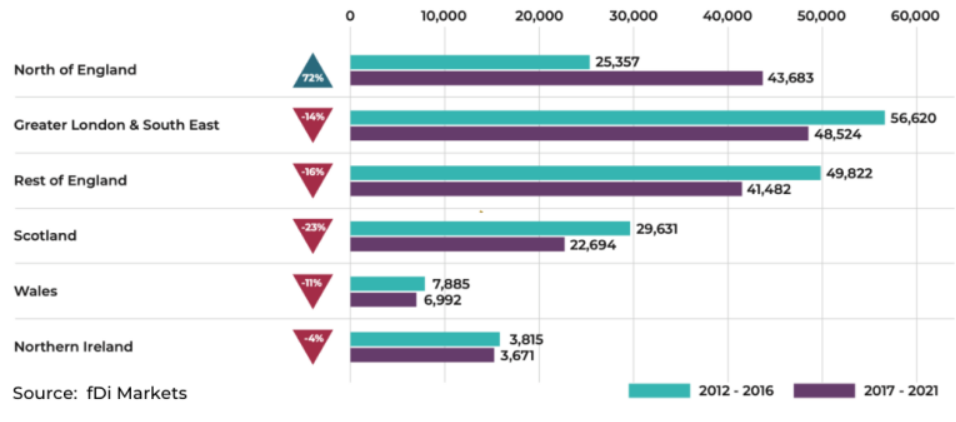
Our new report ‘The Internationalisation of the Northern Powerhouse’ also found that the North increased its share of overall FDI into England, from 19% in 2012-16 to 33% in 2017-21.
This rise means that the region – which makes up roughly 28% of England’s population – is now punching above its weight and drawing in more inward investment on a per capita basis.
Data showed this growth is supporting employment opportunities in the region, with the number of jobs created in the North from inward investment rising from roughly 52,600 in 2012-16 to 62,100 in 2017-21 – an 18% uplift.
The rest of England saw a rise of just 1% over the same time period, while Scotland, Wales and Northern Ireland all saw drops of -19%, -41% and -37% respectively.
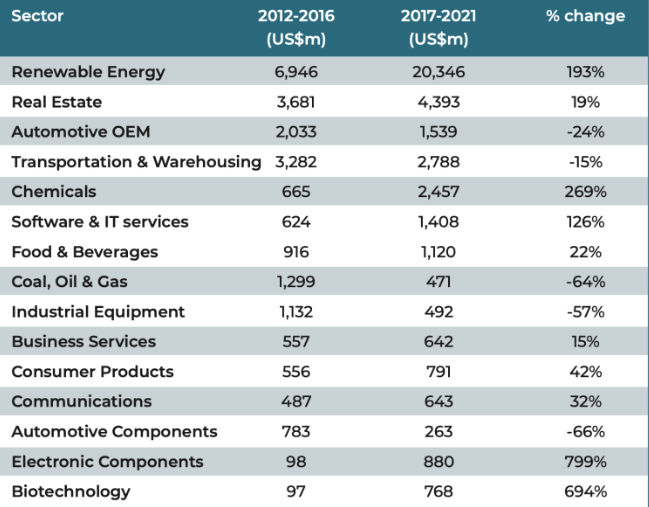
Foreign investment into renewable energy in the North of England has increased from $6.95bn between 2012-16 to $20.25bn 2017-21 – a 193% rise – in a major win for the net zero transition.
Other industries which saw growth over the same period were electrical components (799%), chemicals (269%) and biotechnology (694%), reflecting Northern comparative advantages in sectors such as advanced manufacturing and materials.
Industrial sectors in the Northern Powerhouse receiving the greatest value of FDI 2012-21
The North’s success in attracting inward investment can be largely attributed to policies in George Osborne’s original Northern Powerhouse strategy, which saw a much bigger focus on promoting Northern projects to foreign investors, with the then-Chancellor leading trade delegations overseas, including to Asia, with Northern city leaders.
Greater Manchester has performed consistently well, with the North East and South Yorkshire seeing significant upsurges in recent years.

The North has seen a 7% growth in FDI from Asia over the past decade, while this dropped by 56% for the UK as a whole.
A skilled labour market was cited as the biggest driver for attracting investment, followed by proximity to markets or customers; domestic market growth; transport infrastructure; industry cluster and technology and innovation.
NPP is calling for central and regional government, alongside the private sector, to collaborate better and deliver a five-fold increase in investment to promote Northern projects overseas.
Metro mayors should be given the automatic ability to create at least one freeport or other investment-based enterprise zone, the report says, following the success of tax incentives in projects such as Teesworks in the North East.
Lord Jim O’Neill, vice-chair of the Northern Powerhouse Partnership, said: “The mission to put the Northern Powerhouse on the world map has been a resounding success and a huge amount of credit should go to the genuine cross-party effort between central government and northern civic leaders to make this happen.
“We have been particularly successful in Asia – while the rest the UK has seen FDI from Asia plummet $28bn, 56%, over the last five years, it’s gone up 7% in the North. I often felt that the Northern Powerhouse concept was better understood by investors in Asia than it was among politicians and financiers in London.
“This is proof of the North’s economic potential, especially in innovative and green industries. If the rest of the world sees it, then our own government should be putting us front and centre of their growth strategy.”
Jonathan Reynolds, shadow business secretary, said: “There are fantastic industries and opportunities across the North of England but the Government are failing to make the most of the successful innovation that is happening here.
“This report is great news, but we must build on this success with long term consistent plans that businesses can invest alongside. Labour’s Industrial Strategy will support investment, innovation and offer the certainty northern business needs to prosper.”
Jessica Bowles, Strategy Director at Bruntwood, said: “These latest figures may come as a surprise to many, but not to those of us in the North who are witnessing first hand the rapid pace of change and innovation here. The North is full of entrepreneurial people, fast-growing companies and revolutionary ideas, so it is exciting to see the global investment market respond to this and commit to the regions here.
“But we’re ambitious, and we don’t want to stop here. We will continue to collaborate with private sector partners and local and regional governments to ensure the North is being showcased on the world-stage to encourage further investment and the subsequent growth of our regional ecosystems.”
A Stockton scaffolding company says working on a new landmark development will both build its reputation and provide a foundation for its apprentices’ careers.
JMAC Scaffolding is one of a dozen North East businesses involved in the construction of the four-storey Six Centre Square in the heart of Middlesbrough.
When it is finished early next year it will become the regional HQ of insurance giant AXA UK and 450 of its staff will move there.
They will join around 1,000 office workers who are already based in Centre Square’s two completed buildings.
Work on the new multi-million pound building began in January. The main contractor is Bowmer+Kirkland, which has a North East regional office near Sunderland. It has sub-contracted 90% of the project to businesses based in the region. Together they will receive £6.25m.
More than 60% of the work has gone to companies – such as JMAC – which are located within 30 miles of Middlesbrough. Those contracts are worth £4.4m.
JMAC Construction Director Aaron Kitson said securing the Centre Square contract represented a major breakthrough for his company: “We’d wanted to work with Bowmer+Kirkland for a long time and we were also determined to be involved in one of the biggest projects in Middlesbrough, which is right on our doorstep.”
JMAC was founded by James McCarthy Senior in 1981. His grandson Luis is the current managing director for JMAC Group, which includes JMAC Scaffolding and JMAC Safety Systems.
The JMAC Group employs 170 people from the Teesside area, including five apprentices, and plans to recruit a further five apprentices later this year. JMAC is looking to increase its apprentice intake to between 15 and 20 per year.
“Our best scaffolders are ones that we’ve home grown. We bring them through, we train them ourselves and within five years we shouldn’t have any problems with a shortage of skilled labour,” said Mr Kitson, who joined the company as a scaffolder and rose through the ranks to become a director.
All of the apprentices start their careers with a stint at JMAC’s yard. There – as well as beginning their training – the company makes sure they demonstrate the right attitude and work ethic. “We can’t teach that,” said Mr Kitson.
“You have to enjoy what you do, otherwise it’s a long day – particularly in the winter.” With the most workplace deaths caused by falling from a height, safety training for the young scaffolders is a priority.
The new recruits spend time with different teams of experienced scaffolders working across JMAC’s residential, industrial and commercial contracts, such as Centre Square.
Eighteen-year-old apprentice Tom Payne from Hartlepool said: “You’re learning something new every day.”
Louie Peebles, also 18, who lives in Stockton, said: “It’s outdoors. It’s very physical. The people and supervision are nice and friendly. I get on with them really well and they’re willing to teach you.”
Cameron Blyth, 17, from Billingham, said: “I wasn’t that keen on heights when I started, but I’m getting more confident now thanks to the team around me.”
The Centre Square development was launched six years ago by developer Ashall Projects in partnership with Middlesbrough Council.
Managing Director Mark Ashall said: “The benefits are already being felt – from the young scaffolders starting out on their careers to the professional services companies looking forward to growing their businesses after moving into Centre Square.
“We are creating high quality and sustainable office environments which are proving highly attractive to employers who have quickly transformed Centre Square into the business hub of Teesside.
“They are providing well-paid jobs and that new spending power will also benefit the shops and restaurants which are just a short walk from the offices.”
Although AXA has taken much of the space in 6 Centre Square, 14,000 sq ft is still available. Details of the next phase of the development are due to be announced soon. Outline planning permission is already in place.
A Teesside company has been awarded the contract for the accessible washrooms in the prestigious new Boho X building in central Middlesbrough.
Billingham-based, NYMAS Group specialises in world-class accessible washroom accessories and Doc M packs designed to make buildings inclusive for people with a diverse range of needs. The business also offers design and consultancy services to help developers meet their obligations around accessibility.
NYMAS Group has worked on many prestige commercial and hospitality projects in the UK and around the world, supplying to high-profile clients including Diageo, Hilton Hotels, Ralph Lauren and Dorchester Collection to name a few. This latest contract will see NYMAS group supply luxury accessible washrooms to Boho X, part of an ambitious scheme to transform Middlesbrough into the UK’s digital and creative capital.
One of the boldest structures to be added to Middlesbrough’s portfolio of office space, the 60,000 square foot building will attract cutting-edge digital businesses to the area, and will enable existing businesses to grow.
The seven-storey office block will be situated between Gosford Street and Feversham Street, within the south east of the Boho regeneration area. It will include a lecture theatre, café, swimming pool, gym, event space and public realm area.
The washrooms at Boho X will be finished to a deluxe standard, featuring stylish, matt black accessories to ensure they are in line with the ultra-modern aesthetic of the building – a finish more commonly found in the high-end office blocks of the City of London. Completion is expected by December this year.
NYMAS Group’s Business Development Director, Brad Culmer, commented: “We are absolutely thrilled to be awarded the contract for Boho X – a building that represents an enormous investment in the Teesside area as a future digital hub.
“As a local Teesside firm, we are delighted to see the North-East’s potential being recognised and promoted through developments such as this, and excited to be involved in such a prestige project right here on our doorstep. Our range of inclusive accessories and Doc M packs is designed to cater for every level of need, and we hope this will lead to more opportunities within our local area.”
Middlesbrough-based Render Alarms put their people at the very heart of their service. The firm, which has been operating for more than 30 years, designs, installs, and maintains fire and security systems.
IT Manager, Mike Dickons, explained: “Render Alarms offer services within a 30-mile radius of our Middlesbrough Office as we believe in offering our customers a local service, with engineers they know and trust.”
Having a high-skilled, well-trained team of engineers is central to securing the business’s future success and the firm is putting an emphasis on apprenticeships to help plug skills gaps, now and in the future.
Mike told us: “The Fire and Security industry has a massive shortage in qualified engineers. The majority of Fire & Security companies in the country are looking to expand their engineering teams. We see apprentices as the future of the business and the best way to grow the business.”
The business had previously secured apprenticeship funding in 2017 but recently needed more help as there were no providers available locally offering the apprenticeship standard they needed.
Mike said: “Recent changes in the industry stipulated that apprentices must complete a Fire, Emergency and Security Systems (FESS) qualification as part of their apprenticeship, but the closest supplier was over an hour’s drive away which isn’t practical for an apprentice. We really were in a difficult situation as we rely on apprentices coming through to grow the company.
That’s where the Skills for Growth team came in. They supported the business and worked with the Education Training Collective to introduce the standard locally at Redcar College. Three apprentices from Render Alarms enrolled on the programme to complete their level 3 FESS Technician standard, alongside a further eight apprentices from other local security companies who also benefited from the new training standard.
Mike continued: “Our Skills Development Officer worked hard to identify potential providers and discussed the possibilities with them. Skills for Growth saved us by finding a training provider who could deliver the course we needed for our apprentices – without that we would never have been able to take on another.”
Thanks to this joined up working, Render Alarms is looking forward to welcoming more apprentices into the business.
Mike said: “It fills us with pride to see our apprentices develop, fresh out of school and having never held a screwdriver in their hands, to being fully competent engineers going out on their first job. They then go on to train new apprentices and help the company to grow.”
It’s not just apprentices within the business to benefit. The current management structure will be evolving as the original directors are starting to prepare for retirement. Three members of the engineering team have been earmarked to take over in the future.
These employees will need upskilling to get to grips with strategic growth and planning, as well as leadership and management skills. Skills for Growth introduced the team to two fully-funded courses to support this development, including a three day ‘Going for Growth’ course with Enterprise Made Simple, as well as a six-month ‘Leading Growth’ programme delivered by Teesside University.
The Skills Development Plan also identified digital skills gaps and the need for IT, cyber security and social media training to futureproof the business, as well as additional health and safety standards.
The Skills for Growth team introduced the business to seven more fully-funded courses and programmes, with a total of 18 employees now enrolled across relevant training.
Find out more about Skills for Growth.
Pioneer Procurement is a manufacturing and injection moulding company established on the Riverside Park Industrial Estate in Middlesbrough. After more than twenty years providing high quality production services to many sectors, Pioneer decided to launch their own innovative product range, an animal containment, or “playpen for pets”.
Their MD, Liam Eley, explains that he was inspired to produce the product because he needed something to contain and organized his own chickens, and the available product – chicken wire – was inadequate.
The new product is a “ring fence for animals”, mainly for smaller domestic pets, but could also be for chickens and even children. A picket fence in plastic, a fence with a gate, the product will be sold in panels of 4m o 8m, 850mm high x 1m in length.
The product uses virgin high-strength polymer and recycled plastic.
The product is perfect for gardens and, since it’s totally portable, caravan holidays and other places where people want to take their pets but keep them under control. The pen can be fixed to grass and soil, but also works on decking.
Liam sought support from Innovate UK EDGE when his product was at prototype stage. Local IUK innovation specialist, Peter Dale, based at Teesside University, provided Pioneer with advice and access to funding and other support to help them with the development and launch of their new product.
This support includes access to £15,000 of service support from Innovate UK EDGE’s RTO/Catapult network, funding for moulds from the Tees Valley Business Growth fund and marketing support from Teesside University’s Growth Spark fund. Liam was also able to take advantage of IUK EDGE’s Design for Growth programme, which provides coaching in design thinking.
Regarding this support, Liam comments:
“It was very useful support. My design coach was very helpful in the whole process of defining and developing a brand for the new product. I would highly recommend this programme.”
If you’d like more information on how Innovate UK EDGE can help your business, contact Peter Dale at Peter.Dale@innovateukedge.ukri.org or 07385 390339
Staff from AXA UK have had a first look round their new multi-million pound Middlesbrough headquarters.
When the building – 6 Centre Square – is finished early next year 450 AXA employees will move to a spacious and sustainable working environment which was designed to make the best use of natural light.
As well as a tour of their new HQ, the AXA team visited the offices of GB Bank which has just moved into one of the first two buildings of the initial Centre Square project.
Liz Ferry – Investor and Community Relations for GB Bank – said: “Even when it was empty the space was beautiful. There was so much bright light and we wanted to incorporate that into the way we work.”
Although GB Bank’s employees can split their time between home or office working, extra desks had to be added because staff were so impressed by their new surroundings they wanted to spend more time there, she said.
GB Bank’s visitors said the design of the office had given them food for thought. “The light in a modern building makes you feel really positive about going to work,” said Jamie Simmons of AXA UK. “Rather than sometimes thinking home’s better, it will also be a pleasure to come into the office.”
The new building is on target to be ready early next year and has already made a strong impression. “It’s brilliant – the difference between what we have now and what we can look forward to,” said Mr Simmons.
The Centre Square development was launched five years ago by Ashall Projects in partnership with Middlesbrough Council. Six Centre Square – is being funded and bought by the Tees Valley Mayor and Combined Authority. Middlesbrough Council is also contributing a £2m grant to the project from its Towns Fund allocation which was provided by the government as part of the levelling up programme.
As well as GB Bank the first two Centre Square buildings have attracted six other companies – XPS, Firstsource, Causeway Technologies, two firms of barristers – Dere Street and Park Square – and the Frazer-Nash Consultancy. Only 5,500 sq ft remains available.
Together the new Centre Square occupiers employ around a thousand people who, as well as enjoying a Grade A office environment, are just a short walk from Middlesbrough town centre’s amenities and transport links.
Plans are already well advanced for Centre Square’s next phase. Ashall Projects has secured outline planning permission for further buildings and it is confident that they will attract more companies to the town centre.
“The great thing about our development now is that we’ve got two completed buildings and a third well on the way and businesses can see that they’re going to get the best possible office space the area has to offer,” said Ashall Projects Managing Director Mark Ashall.
“The green industrial revolution taking place in the Tees Valley is seeing investment on a level never seen before here. The companies involved need office space as well as the support of professional services. That’s why the Frazer-Nash Consultancy, for example, has moved to Centre Square which is rapidly becoming the business district for the area.
“Middlesbrough is moving forward again. Centre Square is bringing jobs, spending power and an exciting future back to the town.”

